Chargeback protection: prevent disputes before they reach your account
Chargeback protection is the set of steps that keep disputes low: scoring risky payments before capture, using 3-D Secure where risk is high, clear billing descriptors and fast refunds, plus good evidence for disputes you still receive. Prevention costs less than fighting, because every chargeback carries a fee and counts toward network monitoring thresholds.
Updated · RiskCogs team
Key facts
- A chargeback is a forced reversal started by the cardholder through their bank, not a refund you choose to give.
- Main causes: stolen-card fraud, friendly fraud, unclear billing, and goods not received or not as described.
- Card networks monitor dispute and fraud ratios, and high ratios can lead to fines or monitoring programmes.
- Many disputes can be avoided with recognisable descriptors, easy cancellation and quick refunds.
Why chargebacks happen
Disputes fall into two groups. Fraud disputes come from payments the cardholder did not make. Service disputes come from real customers who did not recognise the charge, could not cancel, or did not get what they expected. The fixes are different, so label each dispute by reason code.
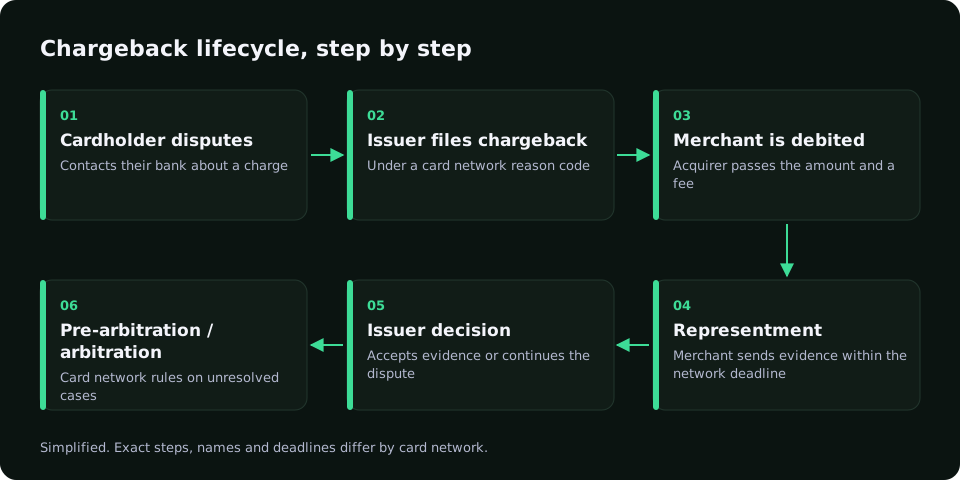
Chargeback prevention in six steps
- Score payments before capture and review or block the riskiest ones.
- Use 3-D Secure for higher-risk payments to add authentication and shift liability.
- Use a billing descriptor customers recognise and a clear support contact.
- Make cancellation and refunds easy; a refund is cheaper than a dispute.
- Keep evidence: order details, delivery proof, logs and customer messages.
- Feed every chargeback back into your fraud rules so the same pattern scores higher next time.
Dispute types and how to prevent them
| Dispute type | Common cause | Prevention |
|---|---|---|
| Fraud, card not present | Stolen card details | Risk scoring, 3-D Secure for high-risk orders |
| Friendly fraud | Buyer forgets or regrets a purchase | Clear descriptor, receipts, easy refunds |
| Subscription dispute | Hard to cancel or surprise renewal | Renewal reminders, one-click cancellation |
| Not received | Delivery failure or false claim | Tracking and delivery confirmation |
| Not as described | Mismatch with product page | Accurate listings, fast support |
How RiskCogs supports chargeback prevention
RiskCogs scores each payment before you capture it and explains the result with reason codes, including chargeback and refund history linked to the same email, phone or card. When a dispute arrives, you send the outcome back through the feedback API with the riskId, so similar payments score higher in the future.
RiskCogs does not handle dispute filing or representment; it helps you decide earlier which payments to review, step up or decline.
See what you would have blocked — free shadow modeFrequently asked questions
What is the difference between a chargeback and a refund?
A refund is a payment you return by choice, usually after the customer asks. A chargeback is started by the cardholder through their bank, reverses the funds by force and usually adds a fee. Chargebacks also count toward card network monitoring ratios, while ordinary refunds do not.
Can I fully prevent chargebacks?
No business can avoid every dispute, because some come from honest misunderstandings or delivery problems. You can cut them sharply by stopping fraud before capture, making charges recognisable, offering quick refunds and keeping strong evidence, so the disputes you do receive are fewer and easier to win.
Does 3-D Secure protect against chargebacks?
For fraud disputes on authenticated payments, liability often shifts to the card issuer, which helps. It does not cover service disputes such as items not received or subscriptions customers forgot to cancel. Use it for higher-risk payments and handle service causes with clear policies and support.
How should chargebacks feed into fraud prevention?
Every chargeback is labelled data. Link it to the original payment, note the reason code and send it back to your fraud system. Over time, the email, card, device and network patterns behind those disputes raise the score of similar new payments before they become chargebacks.
Sources and related reading
- Visa, Visa Core Rules and Visa Product and Service Rules (public edition), dispute resolution chapter.
- Mastercard, Chargeback Guide (public edition).
Measure first. Enforce when ready.
Run RiskCogs in shadow mode next to your existing payment setup and review the decisions before they affect a single customer.