
Banking fraud: what online merchants actually need to stop
Banking fraud for merchants is less about bank branch crime and more about stolen cards, coerced transfers and account takeover that hit your checkout. The useful response is risk scoring before capture, step-up authentication on medium risk, and clear playbooks when a customer later disputes a payment with their bank.
Updated · RiskCogs team
Key facts
- Most merchant losses labelled banking fraud are card-not-present payments or account takeover at checkout.
- Authorised push-payment scams usually hit the payer; merchants still see fallout as disputes and fraud reviews.
- 3-D Secure helps many fraud disputes after successful authentication, but not service disputes.
- Feeding dispute outcomes back into rules improves the next score more than one-off blocks.
What merchants mean by banking fraud
Search demand for banking fraud is often consumer-led, but merchants need a clear operational definition. In practice it covers payments funded with stolen cards, logins that take over a stored card, and social-engineering cases where a real customer is tricked into paying.
Wire and instant-transfer scams are usually fought by banks on the payer side. Merchants still feel them when goods ship before a recall, or when support volume spikes after viral scam patterns.
- Stolen card payments at ecommerce checkout.
- Account takeover using saved wallets or cards.
- Friendly disputes after a real purchase.
- Mule accounts used to move goods or balances.
Signals that matter at checkout
- New device or network on a high-value first order.
- BIN country mismatch with IP and shipping.
- Velocity spikes across cards, emails or devices.
- Email or phone reused across many young accounts.
- Sudden change of payout or shipping details after login.
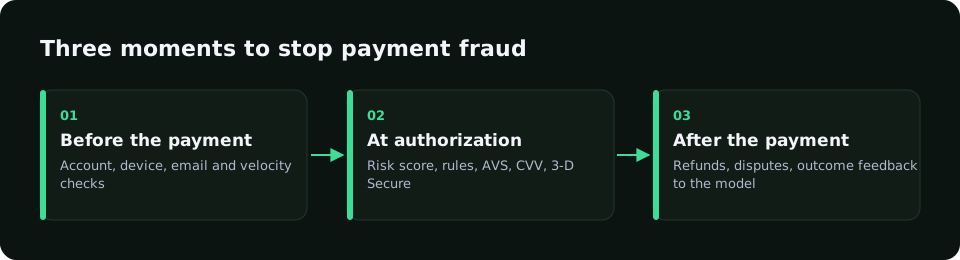
Controls that reduce merchant loss
- Score every payment before capture.
- Use 3-D Secure on medium risk instead of blanket challenges.
- Hold fulfilment on high-risk digital goods until review finishes.
- Make refunds and cancellation easy to cut avoidable disputes.
- Send every fraud and dispute label back into rules.
How this differs from pure AML monitoring
AML monitoring follows regulatory obligations for money laundering. Merchant fraud prevention focuses on stopping loss before capture. Signals overlap, but owners, SLAs and tools often differ. Keep both programmes, and do not assume AML alerts replace checkout scoring.
How RiskCogs helps
RiskCogs returns a 0–100 risk score with reasons on POST /v1/risk-score so your backend can approve, review or decline before the payment provider captures funds. Shadow mode shows what would have blocked without touching customers.
RiskCogs is not a bank and does not process payments. See /pricing/ for plans.
See what you would have blocked — free shadow modeFrequently asked questions
What is banking fraud for an online merchant?
It usually means payment fraud that starts in banking channels: stolen cards, takeover of accounts that hold saved cards, or customers tricked into paying. Merchants stop most of it with scoring before capture, targeted authentication and fast refunds when a real customer complains.
How is banking fraud different from chargebacks?
Banking fraud is the attack pattern. A chargeback is one bank dispute outcome that may follow. Preventing risky payments cuts fraud chargebacks; clear billing and easy refunds cut service chargebacks. You need both tracks.
Can 3-D Secure alone stop banking fraud?
It helps on many authenticated fraud cases and can shift liability, but it does not fix friendly disputes or every takeover where the victim approves the challenge. Combine it with device, velocity and history signals.
What should we measure weekly?
Fraud rate, false-decline rate, 3-D Secure challenge success, and dispute rate by reason code. If false declines rise after a hard rule, loosen that rule or move hits to review before you lose good customers.
Sources and related reading
- European Banking Authority, public opinions and RTS materials on strong customer authentication.
- Visa and Mastercard public dispute and fraud monitoring materials.