Payment fraud prevention: methods that work for online payments
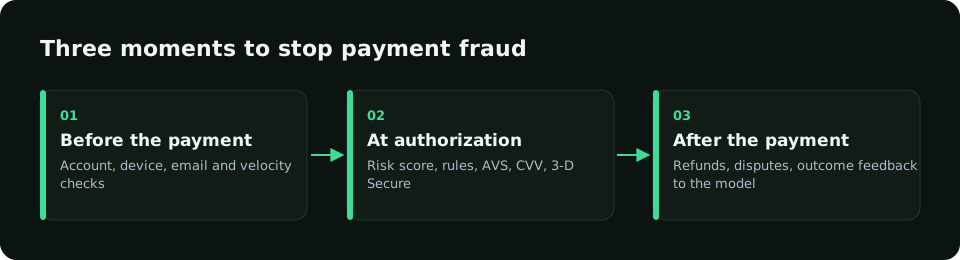
Payment fraud prevention combines several layers: authentication such as 3-D Secure, real-time risk scoring of each payment, velocity limits, allow and block lists, and manual review for unclear cases. The goal is to stop stolen-card, testing and takeover fraud while keeping approval rates high. Test every change on real traffic before you enforce it.
Updated · RiskCogs team
Key facts
- Card-not-present payments carry most online payment fraud, because the physical card is never checked.
- Layers work together: authentication proves the cardholder, risk scoring judges the context.
- False declines are a cost too, so measure approval rate next to fraud loss.
- Rules that are not tested on real traffic first often block more good customers than expected.
Types of payment fraud
- Stolen-card fraud with card details from breaches or phishing.
- Card testing and BIN attacks that validate stolen or generated cards.
- Account takeover that uses saved payment methods.
- Friendly fraud, where a real cardholder disputes a real purchase.
- Refund and promotion abuse.
Payment fraud prevention methods
- Authenticate higher-risk payments with 3-D Secure and confirm AVS and CVC results.
- Score each payment in real time with device, IP, BIN, email and history signals.
- Set velocity limits per card, device, IP and email.
- Keep allow, watch and block lists for known good and bad entities.
- Send unclear payments to manual review with the reasons visible.
- Report outcomes back and recheck rules after every attack.
Prevention methods compared
| Method | Strength | Limit |
|---|---|---|
| 3-D Secure | Strong cardholder check, liability shift | Adds friction, not for every case |
| AVS and CVC checks | Cheap basic validation | Limited coverage, easy to pass with full card data |
| Velocity limits | Stops bursts and testing | Needs tuning per business |
| Risk scoring | Weighs many signals at once | Needs outcome data to stay sharp |
| Manual review | Human judgement on edge cases | Slow and costly at scale |
How RiskCogs fits into payment fraud prevention
RiskCogs is a risk scoring layer that sits next to your existing payment provider. You send a payment to POST /v1/risk-score and get back a score with reason codes, such as negative AVS enrichment, a successful 3-D Secure result, BIN prepaid or virtual flags, IP and geo mismatches, and list matches. Default bands are allow under 40, review 40 to 69 and block from 70, and you can tune them.
Shadow mode is free, so you can compare its decisions with your real outcomes before you act on them.
curl -X POST https://YOUR_RISKCOGS_API_HOST/v1/risk-score \
  -H "X-API-Key: $RISKCOGS_SECRET_KEY" \
  -H "Content-Type: application/json" \
-d '{"requestId":"order-1001","flowType":"checkout","email":"[email protected]","ip":"203.0.113.45","money":{"amount":"49.00","currency":"EUR"}}'Frequently asked questions
What is the most effective payment fraud prevention method?
There is no single best method. The most effective setup layers authentication, real-time risk scoring, velocity limits and lists, with manual review for unclear cases. Each layer catches what the others miss, and outcome feedback keeps the scoring accurate as fraud patterns change over time.
How do fraud prevention tools reduce false declines?
They weigh many signals instead of rejecting on one, give credit to returning customers with good history, and route borderline payments to review or 3-D Secure instead of declining them. Testing rules on real traffic before enforcement shows how many good payments a change would affect.
What should I look for in a payment fraud prevention tool?
Look for clear reasons behind each score, rules you can read and change, a way to test changes on real traffic without risk, easy integration with your current payment provider, and transparent pricing. Also check what data it collects and how it handles consent and card data.
Sources and related reading
- EMVCo, EMV 3-D Secure specification overview.
- PCI Security Standards Council, PCI DSS v4.0.
Measure first. Enforce when ready.
Run RiskCogs in shadow mode next to your existing payment setup and review the decisions before they affect a single customer.