
Fake account creation: detection signals and prevention steps
Fake account creation is when people or bots open accounts that are not genuine customers, often to farm trials, promotions or trust. It overlaps with multi-accounting and account creation fraud. Teams detect it by linking devices, emails and payment methods across signups, watching velocity, and scoring new accounts before costly actions are allowed.
Updated · RiskCogs team
Key facts
- Fake accounts power trial abuse, promo farming, spam, marketplace collusion and review fraud.
- Email-only uniqueness checks fail against aliases, disposable domains and plus-addressing.
- Device and payment-method links catch farms that rotate emails.
- Friction should scale with risk: soft checks for most signups, harder steps for linked or automated ones.
What is fake account creation?
Fake account creation means opening accounts that do not represent a real intended customer relationship. Attackers use them for free trials, coupons, referral bonuses, fake reviews, marketplace collusion or later account takeover staging.
Related terms are account creation fraud, multi-accounting and sybil attacks. The common thread is many identities controlled by one person or botnet.
How fake signup farms work
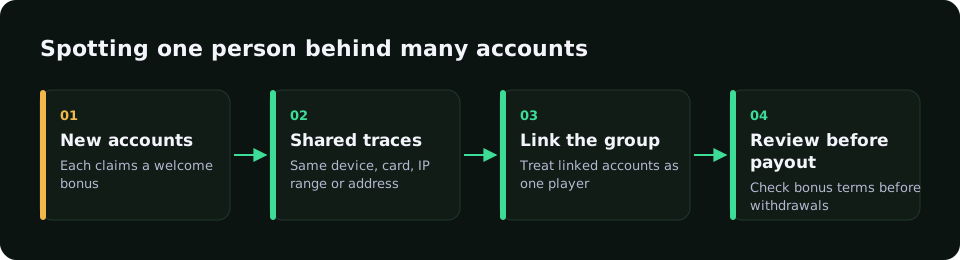
- Generate or buy emails, including disposable domains and aliases.
- Open a fresh browser profile, emulator or anti-detect tool.
- Hide origin behind a VPN, proxy or residential IP pool.
- Optionally add a virtual or prepaid card when the flow asks for payment.
- Claim the trial, promo or trust benefit, then repeat.
Signals of account creation fraud
Treat clusters as stronger evidence than any single odd signup.
Prevention without crushing conversion
- Normalise emails before uniqueness checks.
- Score signup and the first payment-method check together.
- Limit one high-value benefit per durable device or payment method where you can link them.
- Challenge medium-risk signups; block only clear linked farms.
- Run new rules in shadow mode before enforcement.
Fake account signals
| Signal | Suggests | Action |
|---|---|---|
| Same device across many new accounts | Multi-accounting | Raise score; one benefit per device |
| Disposable email domain | Low-commitment identity | Flag; require stronger verification |
| Email aliases of one mailbox | Identity cycling | Normalise; link accounts |
| Automation / emulator traces | Bot farm | Challenge or block |
| Shared card BIN fingerprint on many signups | Payment method farming | Limit benefits per payment method |
| Signup velocity per IP or subnet | Automated creation | Rate-limit |
How RiskCogs helps with fake account creation
RiskCogs links events by device, account, card BIN and IP, so linked signups show up in the score and its reasons. Velocity rules can run in shadow mode beside your current checks before you enforce them.
For trial and promo flows, score the first payment-method check so linked cards and devices surface even when the signup form looked clean. RiskCogs is a risk scoring layer next to your payment provider and does not process payments. See the pricing page for current plans.
See what you would have blocked — free shadow modeFrequently asked questions
What is fake account prevention?
Fake account prevention is the set of checks that stop non-genuine signups from getting trials, promotions or trust. It combines email normalisation, device linking, bot signals, payment-method limits and velocity rules. The goal is to raise cost for farms without blocking ordinary customers who make one honest account.
How do companies detect fake accounts?
They link new signups to earlier ones with device, email and payment signals, and they watch signup velocity. Disposable domains, automation traces and many accounts on one device are common clues. A single clean form fill is weak evidence; the graph of links across accounts is what matters.
Does requiring a phone number stop fake accounts?
It raises the cost of casual repeats but does not stop farms that buy SIM numbers or VoIP ranges. Combine phone checks with device linking, email normalisation and velocity limits. Measure signup conversion when you add phone friction so you know what real users drop.
How is fake account creation related to free trial abuse?
Trial abuse often depends on fake or rotating accounts. Stopping linked signups removes much of the fuel for trial cycling. See also our guide on free trial abuse for the payment-method and cancel-before-billing pattern that sits on top of multi-accounting.
Sources and related reading
- Ahrefs Keywords Explorer, United States, 2026-11-05 (queries: fake account prevention; account creation fraud; prevent fake account creation).