
Promo abuse fraud: spot coupon and referral farming early
Promo abuse fraud is when people or bots claim promotions they are not meant to stack or repeat, using new accounts, emails or payment methods. It overlaps with free trial abuse and bonus abuse. Merchants detect it by linking devices and payment methods across claims, limiting one benefit per durable identity, and scoring redemption events before fulfilment.
Updated · RiskCogs team
Key facts
- Promo abuse covers coupons, referrals, welcome credits, free gifts and matched deposits.
- Farms rotate emails and cards while reusing devices, browsers or addresses.
- Single-code checks fail when the attacker opens a new account for each claim.
- Shadow-testing redemption rules protects conversion during big campaigns.
What is promo abuse fraud?
Promo abuse fraud is the misuse of marketing offers: claiming the same welcome deal many times, stacking codes against the rules, or referring yourself through linked accounts. In iGaming the same idea is often called bonus abuse.
It sits next to free trial abuse. The user may be a real person; the harm is unpaid margin, skewed acquisition metrics and inventory taken from genuine customers.
Common promo abuse patterns
- New account per coupon or referral reward.
- Self-referral rings sharing devices or payment methods.
- Stacking codes that the rules forbid.
- Buying only the free gift and never returning.
- Using virtual cards to pass one-per-card limits.
How to detect promo abuse
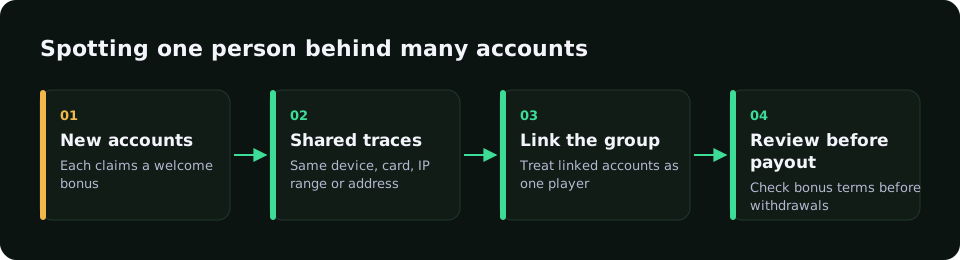
Score the redemption, not only the signup. Link the benefit claim to devices and payment methods used on earlier claims.
Controls that usually work
- One welcome benefit per durable device and per payment method where you can link them.
- Normalise emails and block disposable domains on high-value offers.
- Velocity limits on redemptions per IP, device and card fingerprint.
- Hold fulfilment of high-value gifts until risk review on medium scores.
- Test campaign rules in shadow mode before a launch.
Promo abuse signals
| Signal | Suggests | Action |
|---|---|---|
| Many redemptions per device | Farming | One benefit per device |
| Shared card across welcome claims | Payment method cycling | Limit per payment method |
| Referral edges forming a tight ring | Self-referral | Graph review; hold payout |
| Disposable emails on high-value codes | Low-commitment claims | Require stronger identity |
| Automation at redeem time | Bot farm | Challenge or block |
How RiskCogs helps with promo abuse
RiskCogs links events by device, account, card BIN and IP, so linked promo claims show up in the score and its reasons. You can keep new campaign rules in shadow mode, compare matches with confirmed abuse, then promote them when the trade-off looks right.
RiskCogs does not replace your promotions engine. It is a risk scoring layer next to your payment provider and does not process payments. See the pricing page for current plans.
See what you would have blocked — free shadow modeFrequently asked questions
What is promo abuse fraud?
Promo abuse fraud is claiming marketing offers in ways the rules forbid, usually through many accounts or stacked codes. It includes coupon farming, referral rings and welcome-credit repeats. Detection relies on linking identities across claims rather than trusting each new email as a new customer.
How do you prevent coupon abuse?
Limit one high-value code per device and payment method, normalise emails, rate-limit redemptions, and score the redeem event with device and network context. Hold risky fulfilments for review. Test stricter rules on a past campaign in shadow mode before you enforce them on a live launch.
Is promo abuse the same as free trial abuse?
They overlap. Free trial abuse focuses on repeating unpaid product access. Promo abuse covers coupons, referrals and welcome offers more broadly. Both rely on multi-accounting, so the same device and payment-method links help. Use both guides when your product sells trials and run promotions.
Should I block every suspicious promo claim?
Usually no. Hard blocks on weak signals hurt real customers during campaigns. Prefer scores, challenges and delayed fulfilment for medium risk, and reserve hard denies for clearly linked farms. Measure both abuse catch rate and genuine redemption conversion when you change thresholds.
Sources and related reading
- RiskCogs guides on free trial abuse and first-party fraud — internal cross-links.