
Loyalty program fraud: protecting points, rewards and members
Loyalty program fraud is abuse of points, rewards or member perks. Outsiders take over accounts to drain balances, and insiders or members farm rewards with fake accounts, return abuse or referral loops. Points behave like stored value, so protection needs account security, link analysis between members, and rules on redemption and transfer events.
Updated · RiskCogs team
Key facts
- Loyalty points are a form of stored value that can be redeemed or resold.
- Account takeover is a common way to steal balances.
- Fake accounts and referral loops inflate rewards.
- Redemptions and transfers are the highest-risk events.
Common types of loyalty fraud
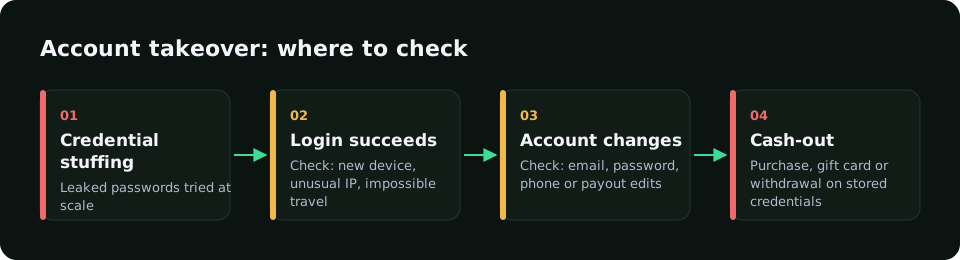
- Account takeover and balance draining.
- Fake account farming for signup and referral rewards.
- Purchase-and-return loops that keep the points.
- Transfers of points to linked or resale accounts.
- Staff or partner abuse of manual adjustments.
Signals worth watching
- New device or location right before a redemption.
- Password or email change followed by a transfer.
- Many members sharing devices, cards or addresses.
- Points earned and redeemed in a very short time.
- Returns soon after high-point purchases.
How to protect a loyalty programme
- Secure login with risk-based step-up for new devices.
- Score redemption and transfer events, not only purchases.
- Link members by device and payment method.
- Hold or delay unusual high-value redemptions.
- Reverse points on returns and refunds.
- Test rules in shadow mode before blocking members.
How RiskCogs helps with loyalty fraud
RiskCogs can score logins, redemptions and transfers as events, with reasons such as new device, linked accounts or unusual velocity. Rules can add a step-up or hold instead of a block.
Linking members by device, account, card BIN and IP exposes farms and takeover patterns. RiskCogs is a risk scoring layer next to your payment provider. It does not process payments and does not file or fight disputes for you. See the pricing page for plans.
See what you would have blocked — free shadow modeFrequently asked questions
What is loyalty program fraud?
It is abuse of a loyalty or rewards programme to gain value unfairly. Examples include taking over member accounts to drain points, creating fake accounts for signup bonuses, referral loops, and buying then returning items while keeping the points.
Why do fraudsters target loyalty points?
Points can be redeemed for goods, travel or gift cards and are sometimes transferable or resold. Accounts are often protected less strictly than payment cards, and members may not check their balance often, so theft can go unnoticed for a while.
How do you detect loyalty fraud?
Score logins, redemptions and transfers, link members by device and payment method, and watch for new devices before redemptions, fast earn-and-burn patterns and returns after high-point purchases. Review clusters of linked accounts before you suspend members.
Does preventing loyalty fraud hurt real members?
It can if rules are blunt. Use step-up checks or short holds for unusual redemptions instead of blocks, test rules in shadow mode, and keep a fast support path for members who get challenged by mistake.
Sources and related reading
- Ahrefs Keywords Explorer, United States, 2026-11-05 (queries: loyalty program fraud; loyalty fraud; points fraud).