
Chargeback recovery services: winning back disputed revenue
Chargeback recovery services help merchants win back money lost to disputes. They collect evidence, match it to the reason code, and submit representment before the network deadline. Recovery only works on valid cases with good evidence, so the best programmes pair it with prevention: fewer bad orders approved means fewer chargebacks to fight at all.
Updated · RiskCogs team
Key facts
- Recovery happens through representment: the merchant answers a chargeback with evidence.
- Each card network sets its own response windows and evidence rules per reason code.
- Fraud reason codes and service reason codes need different evidence.
- Not every chargeback is worth fighting; accepting weak cases saves time and fees.
What chargeback recovery services do
A chargeback recovery service takes over the response side of disputes. It pulls order, delivery, login and communication data, writes a rebuttal that matches the reason code, and submits it through your acquirer or payment provider before the deadline.
Some services work fully managed, others give you software and templates. Either way, the outcome depends on the evidence you can export and on how fast cases reach the team.
How the recovery process works
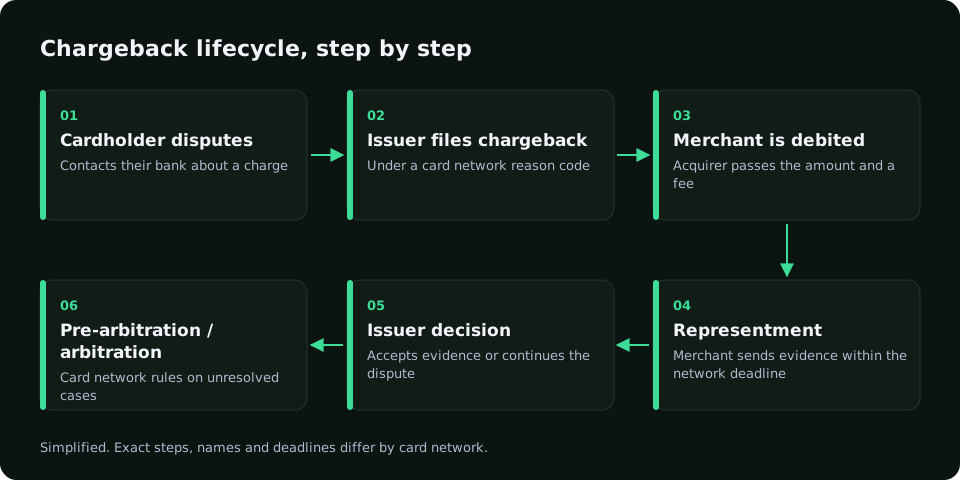
- The chargeback arrives from your acquirer or provider with a reason code and deadline.
- The case is triaged: fight, accept, or refund-and-close where allowed.
- Evidence is collected from order, shipping, account and support systems.
- A rebuttal is written for that reason code and submitted.
- The issuer decides; a lost case may move to pre-arbitration or arbitration.
- Outcomes feed back into prevention rules.
What to ask a recovery provider
- Which reason codes and networks do you handle, and which do you decline?
- How do you get evidence from our stack, and how fresh is it?
- How do you report win rate: per case, per amount, or both?
- What happens with pre-arbitration and arbitration?
- How do you charge? Ask for the full fee model in writing before you sign.
Recovery vs prevention
Recovery wins back part of the money on disputes that already happened. Prevention stops the bad orders that cause many fraud chargebacks, and alerts can resolve some disputes before they become chargebacks.
Most teams need all three: risk scoring at checkout, pre-dispute alerts where available, and representment for the remainder.
Evidence you can collect before a dispute exists
Teams that fight filings later win more often when the original checkout already stored device/session context (with consent), BIN-level card context, matched rules and readable reasons. Capture that while the order is live — not weeks later from memory.
RiskCogs can supply the score, reasons and linked entities during prevention. It still does not file representments or promise outcomes. Pair it with a dedicated recovery vendor for the residual book. Compare roles on the chargeback management software comparison page on this site.
Where each layer acts on a disputed order
| Layer | When it acts | Main goal |
|---|---|---|
| Risk scoring | Before approval | Stop high-risk orders |
| Pre-dispute alerts | After a cardholder complains, before a chargeback | Refund or resolve early |
| Recovery and representment | After the chargeback | Win back valid revenue |
How RiskCogs fits next to recovery
RiskCogs scores payments before approval with reasons you can read, so fewer fraud orders get through and the ones you approve carry device, account and IP context you can reuse as evidence.
Recovery teams can use those score reasons and linked-account signals to decide which cases are worth fighting. RiskCogs is a risk scoring layer next to your payment provider. It does not process payments and does not file or fight disputes for you. See the pricing page for plans.
See what you would have blocked — free shadow modeFrequently asked questions
What are chargeback recovery services?
They are providers or tools that respond to chargebacks on your behalf. They gather evidence, write a rebuttal for the reason code and submit representment through your acquirer or payment provider before the deadline, aiming to recover revenue from disputes that were not valid.
Can every chargeback be recovered?
No. If the order really was fraud by a third party, or the customer has a fair service complaint, evidence rarely wins. Good recovery programmes triage cases, fight the ones with strong evidence, and accept the rest to save time and fees.
How long do I have to respond to a chargeback?
Response windows are set by each card network and passed on by your acquirer, and they can be short. Check the deadline on each case notice, because your provider may set an earlier internal cut-off than the network rule.
Is chargeback recovery the same as chargeback prevention?
No. Recovery acts after a chargeback is filed and tries to reverse it. Prevention acts earlier, at checkout or after a cardholder complaint, and tries to stop the dispute from happening. Combining both usually lowers losses more than either alone.
Sources and related reading
- Visa, Visa Core Rules and Visa Product and Service Rules (public edition), dispute resolution chapter.
- Mastercard, Chargeback Guide (public edition).