
Pre-arbitration and arbitration: the last stages of a chargeback
Pre-arbitration is the stage after representment when the issuer still disagrees with the merchant's evidence and challenges the decision again. The merchant can accept the loss or respond. If they still disagree, the case can go to arbitration, where the card network decides and the losing side usually pays network fees on top of the disputed amount.
Updated · RiskCogs team
Key facts
- Pre-arbitration follows a representment the issuer did not accept.
- Arbitration is decided by the card network, not the issuer or acquirer.
- Network fees at this stage can be significant; check your acquirer's current fee schedule.
- Visa and Mastercard use different names and flows for these stages.
Where pre-arbitration sits in the lifecycle
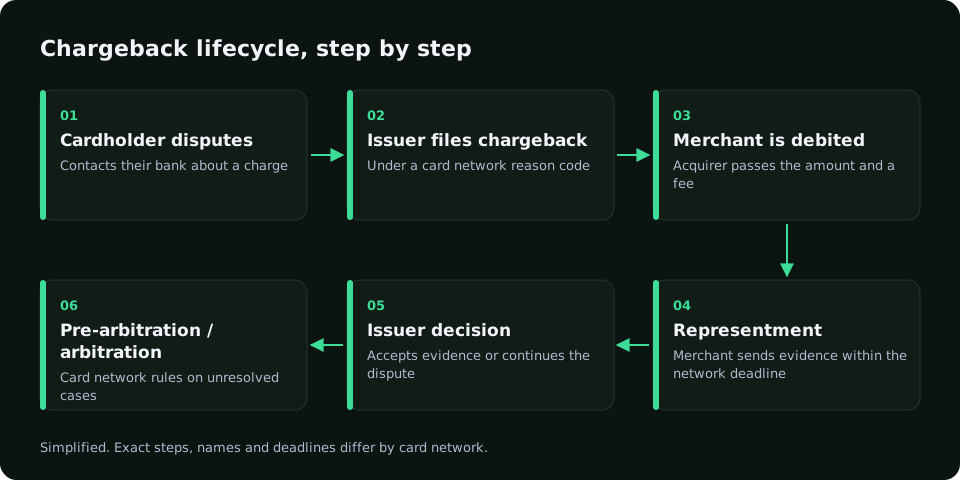
- The cardholder disputes and the issuer files a chargeback.
- The merchant submits representment with evidence.
- The issuer rejects it or adds new information: pre-arbitration.
- The merchant accepts or responds within the deadline.
- Unresolved cases can be filed with the card network.
Visa and Mastercard differences
Visa handles disputes through allocation and collaboration flows, with pre-arbitration and arbitration steps that depend on the dispute condition. Mastercard uses a pre-arbitration step followed by arbitration case filing.
The exact deadlines and evidence rules change over time, so check the current public rules and your acquirer's guidance.
Fight or accept?
- Fight when you have new, specific evidence that answers the issuer's point.
- Accept when the evidence is weak or the amount is small compared with network fees.
- Ask your acquirer for its fee schedule and win history before filing.
- Record the outcome and feed it into prevention rules.
Where RiskCogs helps
Most of these cases start as fraud or friendly fraud disputes. RiskCogs scores payments before approval with device, account and IP reasons, which cuts how many risky orders reach the dispute process.
The score reasons and linked-account history for an order can also support your evidence. RiskCogs is a risk scoring layer next to your payment provider. It does not process payments and does not file or fight disputes for you. See the pricing page for plans.
See what you would have blocked — free shadow modeFrequently asked questions
What is pre-arbitration in a chargeback?
It is the stage after representment when the issuer does not accept the merchant's evidence and challenges again, sometimes with new information. The merchant can accept the loss or respond. If both sides still disagree, the card network may decide the case.
What happens in chargeback arbitration?
The card network reviews the case file from issuer and acquirer and makes a final decision. The losing side usually pays the network's fees in addition to the disputed amount, so both sides weigh the evidence and cost before filing.
Should merchants always fight pre-arbitration?
No. Respond when you have specific evidence that answers the issuer's reason. If the evidence is thin or the amount is small compared with network fees, accepting the loss is often the better business decision.
How long does pre-arbitration take?
Each network sets deadlines for the response and for the final filing, and your acquirer may set earlier internal cut-offs. Check the dates on each case notice, because missing one usually means the case is decided against you.
Sources and related reading
- Visa, Visa Core Rules and Visa Product and Service Rules (public edition), dispute resolution chapter.
- Mastercard, Chargeback Guide (public edition).