
Types of chargebacks and how to respond to each
Chargebacks fall into four broad types: fraud, where the cardholder says they did not make the payment; authorisation and processing errors; consumer or service disputes about goods not received or not as described; and friendly fraud, where a real purchase is disputed anyway. Each card network maps these to its own reason codes, and each type needs different evidence.
Updated · RiskCogs team
Key facts
- Visa groups dispute conditions into fraud, authorisation, processing errors and consumer disputes.
- Mastercard uses its own reason codes for similar groups.
- Friendly fraud usually arrives under a fraud or consumer dispute code, not its own code.
- Matching evidence to the reason code is the core of representment.
Fraud chargebacks
The cardholder says they did not authorise the payment. This includes true third-party fraud with stolen cards and friendly fraud dressed up as fraud.
Evidence that helps: 3-D Secure authentication, device and IP history linking the cardholder to earlier undisputed orders, and delivery to a known address.
Authorisation chargebacks
The payment was processed without a valid authorisation, or after a decline. These are usually operational issues, such as forced posts or expired authorisations, and are fixed in payment flows rather than fought.
Processing error chargebacks
- Duplicate processing.
- Incorrect amount or currency.
- Late presentment.
- Credit not processed after a refund was promised.
Consumer dispute chargebacks
The cardholder admits the purchase but disputes the outcome: goods not received, not as described, cancelled subscription still billed, or defective items.
Evidence that helps: tracking and proof of delivery, clear product descriptions, cancellation terms and logs, and support conversations.
Friendly fraud
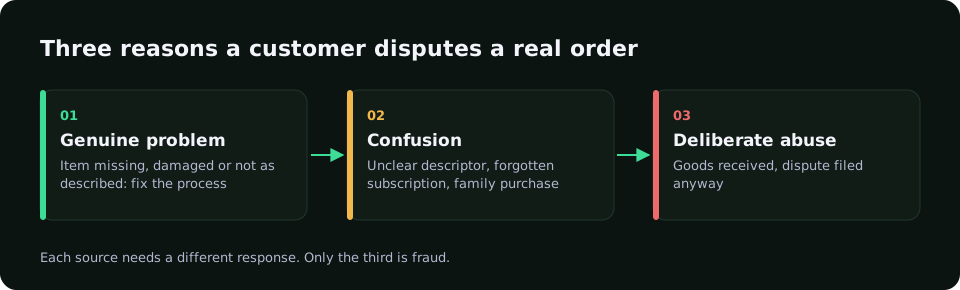
Friendly fraud is a chargeback on a real purchase. It can be deliberate or caused by an unclear billing descriptor or a forgotten subscription. It is a type of first-party fraud and is often filed under a fraud code.
Chargeback types and typical evidence
| Type | Cardholder claim | Typical evidence |
|---|---|---|
| Fraud | I did not make this payment | 3-D Secure result, device and IP history, prior undisputed orders |
| Authorisation | Payment was not properly authorised | Authorisation records |
| Processing error | Wrong amount, duplicate or refund missing | Transaction and refund records |
| Consumer dispute | Not received, not as described, cancelled | Delivery proof, terms, support logs |
| Friendly fraud | Usually framed as fraud or not received | Usage, login and delivery evidence |
How RiskCogs helps across chargeback types
RiskCogs targets the fraud and friendly fraud types before approval. It scores each payment with reasons and links devices, accounts and IPs, so repeat disputers and stolen-card patterns stand out.
Those same reasons and links are useful context when you assemble evidence for fraud-coded chargebacks. RiskCogs is a risk scoring layer next to your payment provider. It does not process payments and does not file or fight disputes for you. See the pricing page for plans.
See what you would have blocked — free shadow modeFrequently asked questions
What are the main types of chargebacks?
The common groups are fraud, authorisation, processing errors and consumer disputes. Friendly fraud is a further pattern where a real purchase is disputed, usually under a fraud or consumer code. Visa and Mastercard each map these groups to their own reason codes.
Which type of chargeback is most common?
It depends on the business. Digital goods and subscriptions often see many fraud-coded and friendly fraud disputes, while physical retail sees more not-received and not-as-described cases. Check your own reason code reports before you plan fixes.
Is friendly fraud a chargeback type?
It is a pattern rather than a separate reason code. The cardholder made the purchase but files a dispute anyway, usually under a fraud or consumer dispute code. Treat it as part of first-party fraud and collect usage and delivery evidence.
Can processing error chargebacks be prevented?
Usually yes. Duplicate charges, wrong amounts, late presentment and missing refunds come from payment operations. Fix the flows, process refunds promptly and reconcile settlements, and most of these disputes go away without needing representment.
Sources and related reading
- Visa, Visa Core Rules and Visa Product and Service Rules (public edition), dispute resolution chapter.
- Mastercard, Chargeback Guide (public edition).