
Chargeback fraud prevention: spotting abuse before it costs you
Chargeback fraud happens when a cardholder disputes a purchase they made and received, to keep both the goods and the money. It is a deliberate form of friendly fraud. Prevention combines clear billing, strong order evidence, linking accounts and devices to find repeat disputers, and risk rules tested in shadow mode before they decline anyone.
Updated · RiskCogs team
Key facts
- Chargeback fraud is deliberate; some friendly fraud is honest confusion.
- Identity checks pass because the cardholder is genuine.
- Repeat disputers often reuse devices, emails, addresses or cards across accounts.
- Good evidence helps in representment, but prevention avoids the dispute entirely.
What is chargeback fraud?
Chargeback fraud, sometimes called cyber shoplifting, is when a real customer files a dispute on a legitimate purchase to get money back while keeping the product. It belongs to the first-party category.
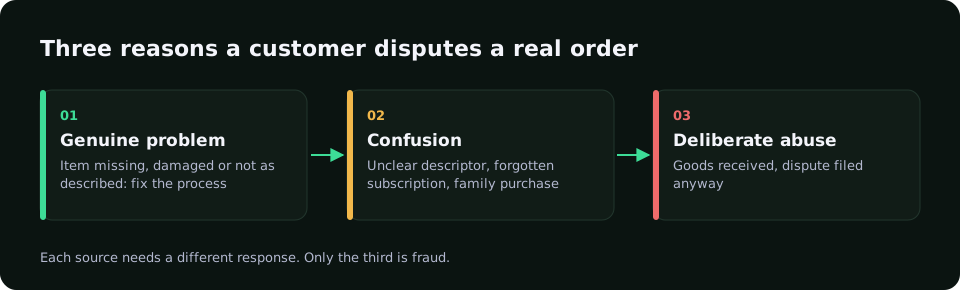
It differs from honest friendly fraud, where a customer does not recognise a charge or forgot a subscription. The fix for honest cases is clarity; the fix for abuse is detection.
Signals of chargeback fraud
- Customer accounts linked to earlier disputes by device, email, address or card.
- Many accounts sharing one device or delivery address.
- Disputes filed soon after confirmed delivery or heavy usage.
- High-value orders from new accounts with little history.
- Patterns around promotions, refunds and trials.
How to prevent chargeback fraud
- Use a clear billing descriptor and send receipts.
- Capture delivery, login and usage evidence for every order.
- Link accounts by device and payment method.
- Flag customers with prior disputes for review or step-up.
- Test new rules in shadow mode before enforcing.
- Feed dispute outcomes back into rules.
How RiskCogs helps prevent chargeback fraud
RiskCogs links events by device, account, card BIN and IP, so customers connected to earlier disputes raise the score with a readable reason. Rules can route them to review, 3-D Secure or decline.
You can try those rules in shadow mode first and compare them with real dispute outcomes. RiskCogs is a risk scoring layer next to your payment provider. It does not process payments and does not file or fight disputes for you. See the pricing page for plans.
See what you would have blocked — free shadow modeFrequently asked questions
What is chargeback fraud?
Chargeback fraud is when a cardholder disputes a purchase they made and received, to keep the goods and get the money back. It is the deliberate type of friendly fraud and a first-party abuse, because the person disputing is the real cardholder.
How do you prevent chargeback fraud?
Make charges easy to recognise, keep delivery and usage evidence, link accounts and devices to find repeat disputers, and review or step up risky orders. Test new rules in shadow mode first so you do not decline honest customers by mistake.
Is chargeback fraud illegal?
Deliberately disputing a legitimate purchase can be treated as a crime in many jurisdictions, but enforcement against individual consumers is rare. For merchants the practical response is prevention, good evidence and closing accounts that repeatedly abuse disputes.
How is chargeback fraud different from friendly fraud?
The friendly variant is the wider term for disputes on real purchases, including honest confusion. Chargeback abuse is the deliberate subset, where the customer knows the charge is valid. Clear descriptors fix much of the first; detection is needed for the second.
What is chargeback fraud protection?
It is the set of controls that stops deliberate disputes on legitimate purchases: clear billing, delivery and usage evidence, account and device linking to spot repeat disputers, and step-up or review for risky orders. Some vendors also sell chargeback guarantees, which reimburse approved orders under a contract rather than preventing disputes.
Sources and related reading
- Visa, Visa Core Rules and Visa Product and Service Rules (public edition), dispute resolution chapter.
- Mastercard, Chargeback Guide (public edition).