
Friendly fraud: why real customers dispute real purchases
Friendly fraud is when a customer makes a genuine purchase, receives what they paid for, and then disputes the charge with their bank instead of asking the merchant for a refund. Some cases are honest confusion, others are deliberate. It looks like a normal chargeback, so merchants have to reduce it with clear billing, easy refunds and good evidence.
Updated · RiskCogs team

Key facts
- In friendly fraud the cardholder made the purchase; the card was not stolen.
- It usually arrives as a fraud or item-not-received chargeback, so it is hard to spot from the reason code alone.
- A large share of cases start as confusion: an unfamiliar billing descriptor, a forgotten subscription or a family member's purchase.
- Fraud scores at checkout catch it less well than stolen-card fraud, because the buyer looks like a good customer at the time.
What friendly fraud looks like
The name is misleading. Nothing about it feels friendly to the merchant. It is called friendly because the person disputing the charge is the real cardholder, often a returning customer, rather than a criminal using stolen details. They bought something, it arrived or the service was delivered, and later they told their bank they did not make the purchase, did not receive it, or that it was not what they ordered.
It is also one of the more frustrating problems in payments, because the customer often feels they did nothing wrong. From their side, they asked their bank a question about a charge. From yours, a sale disappeared, a fee arrived and your dispute ratio went up.
Industry writers also call it first-party fraud or chargeback abuse. Some teams keep these terms separate: friendly fraud for confused or careless disputes, first-party fraud for deliberate ones. The distinction matters for how you respond, but from the payment side they look the same. A chargeback appears, money leaves your account, and you have to decide whether to fight.
Why customers dispute purchases they made
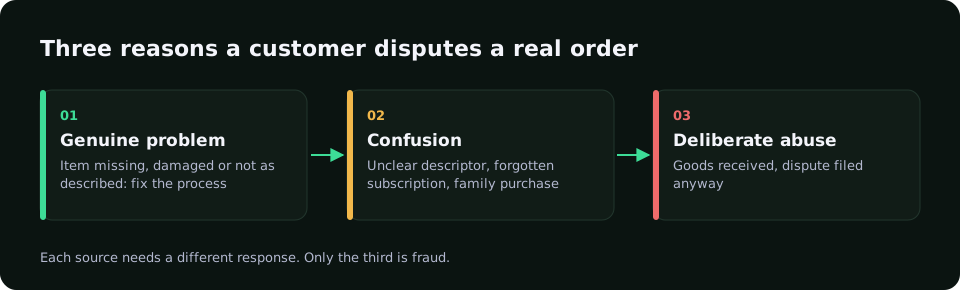
- They do not recognise the charge. The name on the bank statement does not match your brand, or a payment processor's name appears instead.
- They forgot about a subscription or a free trial that turned into a paid plan.
- Someone else in the household used the card: a child buying in-game items, a partner ordering on a shared account.
- They find disputing easier than contacting the merchant, especially if your refund or cancellation path is hard to find.
- They are unhappy with the product and use the dispute as a faster refund.
- They want the goods without paying. This is the deliberate group, and it tends to repeat when it works.
How to tell friendly fraud from true fraud
When a chargeback says the cardholder did not authorise the payment, you need to work out whether that is true. The question is simple: was this the same person who has been buying from you all along, or someone new using their card?
The answer usually sits in data you already have, if you keep it. Look at the device and browser used for the disputed order and compare them with earlier orders. Check whether the IP address and location match the customer's normal pattern. See whether the account logged in normally before the purchase and whether the order shipped to an address used before. Look for earlier orders from the same customer that were never disputed.
If all of those line up with the customer's history, the purchase was very likely made by the cardholder or someone in their household. If the device is new, the IP is from a data center, the shipping address changed shortly before the order and the email was created that day, you are probably looking at true fraud, and representment is unlikely to succeed.
Seven ways to reduce friendly fraud
- Use a clear billing descriptor. Put your recognisable brand name on statements, plus a short website or support contact where your acquirer allows it.
- Send receipts and renewal reminders. An email before a subscription renews prevents many "I never agreed to this" disputes.
- Make refunds and cancellation easy to find. A visible cancel button costs less than a chargeback and its fee.
- Answer support requests fast. Customers who get no reply often go to their bank next.
- Keep evidence by default: device, IP, login history, delivery confirmation and service usage logs, tied to each order.
- Flag repeat disputers. A customer who disputed before and keeps ordering is a real risk, and a hold or review on their next order is reasonable.
- Use 3-D Secure where it fits. Authenticated payments can shift liability for some fraud disputes to the issuer.
When to fight a friendly fraud chargeback
Fight when you have evidence that matches the reason code and the amount is worth the time. For fraud claims, the strongest evidence links the disputed order to the same customer through earlier undisputed orders: the same device, IP address, account or shipping address. Visa's Compelling Evidence 3.0 rules describe how this kind of history can be used for card-absent fraud disputes when the data matches.
For "item not received" claims, use carrier tracking with delivery confirmation, and a signature where you collected one. For digital goods and services, show that the account logged in and used what was bought after the purchase date.
Do not fight disputes that you would lose on the merits, or where the customer has a real point. Spend the effort where the evidence is strong, and fix the process behind the rest.
Friendly fraud in subscriptions and digital goods
Subscriptions and digital goods see more of this than most. There is no parcel to track, the charge often repeats every month, and the customer may not open the app for weeks. When a renewal appears on a statement under an unfamiliar name, a dispute is one tap away in many banking apps.
The fixes are mostly about clarity. Say exactly when a trial ends and what it will cost, in the signup flow and in an email a few days before. Use the same brand name on the statement that the customer saw at checkout. Show the next billing date in the account page. Make cancelling as easy as signing up, because a customer who cannot find the cancel button will find the dispute button instead.
Evidence for digital goods comes from usage. Record logins, downloads, plays or API calls after the purchase date, with device and IP. If a customer says they never bought access but used it every day for a month from the same phone they signed up on, that record is what an issuer needs to see.
In gaming and in-app purchases, family use is a common cause. A parent finds a series of small charges and disputes them all. Clear purchase confirmations, spending limits and an easy way to request a refund directly reduce how often that turns into a chargeback.
Why fraud scoring alone does not stop it
Risk scoring is built to spot payments that look unlike your normal good customers. Friendly fraud comes from customers who look exactly like your normal good customers at checkout, because they are. So a checkout score cannot be the whole answer.
What scoring can do is help afterwards. When disputes are reported back to the scoring system, patterns become visible: customers with earlier disputes, certain products that attract them, accounts that share devices with known disputers. Those signals can push the next risky order into review instead of straight approval. The same records that feed the score also give you the evidence for representment.
How RiskCogs helps with friendly fraud
RiskCogs keeps device, network and history signals for every scored payment, with readable reason codes such as trust_same_device_as_last_approved. When a dispute claims the cardholder never made the purchase, that record shows whether the order came from the customer's usual device and network.
Send chargebacks to POST /v1/risk-feedback with the riskId, and later orders linked to the same customer or device score higher, so you can review them before shipping. Start in shadow mode on the free plan to see how disputed orders scored before you change any rules.
See what you would have blocked — free shadow modeFrequently asked questions
Is friendly fraud illegal?
Deliberately disputing a purchase you made and received to get your money back is a form of fraud in many legal systems. Many friendly fraud cases are honest mistakes, though, such as not recognising a charge or a family member using the card. Merchants rarely pursue individual customers and focus on prevention and evidence instead.
What is the difference between friendly fraud and first-party fraud?
The terms overlap and are often used as synonyms. When teams separate them, friendly fraud covers confused or careless disputes by real customers, while first-party fraud means the cardholder deliberately disputes a valid purchase or deliberately misrepresents themselves to get goods or credit. Both differ from third-party fraud, where a stolen card is used.
Can 3-D Secure prevent friendly fraud?
It helps with one part. When a payment is authenticated with 3-D Secure, liability for many fraud-coded disputes can shift to the issuer, so a claim that the cardholder did not authorise the payment is harder to make stick. It does not help with item-not-received or not-as-described disputes, which need delivery and product evidence.
Should I block customers who filed a chargeback?
Consider each case. If the dispute was caused by your own error or a real problem, blocking a customer who might return is a mistake. If the customer disputed an order they clearly received, putting their later orders into review, or asking for prepayment by another method, is a reasonable and common policy.
Sources and related reading
- Visa, Compelling Evidence 3.0 for dispute condition 10.4, effective April 2023.
- Visa, Visa Core Rules and Visa Product and Service Rules (public edition).
- Mastercard, Chargeback Guide (merchant edition).
Measure first. Enforce when ready.
Run RiskCogs in shadow mode next to your existing payment setup and review the decisions before they affect a single customer.