
What is a chargeback? A merchant's guide to how disputes work
A chargeback is a forced reversal of a card payment. The cardholder asks their bank to dispute a charge, the bank pulls the money back from the merchant through the card network, and the merchant can either accept the loss or answer with evidence. Unlike a refund, the merchant does not start it and usually pays a fee.
Updated · RiskCogs team
Key facts
- A chargeback is started by the cardholder's bank (the issuer), not by the merchant.
- Each chargeback carries a reason code from the card network, such as fraud, item not received or not as described.
- Merchants usually lose the sale amount and pay a dispute fee, even when they later win.
- Card networks monitor dispute levels, and merchants with high ratios can be placed in monitoring programs.
Chargeback meaning in plain words
Chargebacks exist to protect people who pay by card. If someone steals a card and spends on it, or a shop takes money and never ships, the cardholder needs a way to get the money back that does not depend on the merchant being honest or reachable. The card networks built that path into their rules, and the issuing bank runs it on the cardholder's behalf.
For a merchant, that means a sale is not fully final when the payment is approved. For weeks or months after, the cardholder can raise a dispute, and the money can be taken back out of your account. The word chargeback refers to that reversal: the issuer charges the transaction back to the acquirer, and the acquirer passes it on to you.
A refund is different. You decide to give the money back, you control the amount and timing, and there is normally no extra fee or mark on your record. A chargeback is decided by the bank, comes with a fee from your acquirer, and counts against your dispute ratio. That is why a quick, friendly refund is often cheaper than a dispute you could technically win.
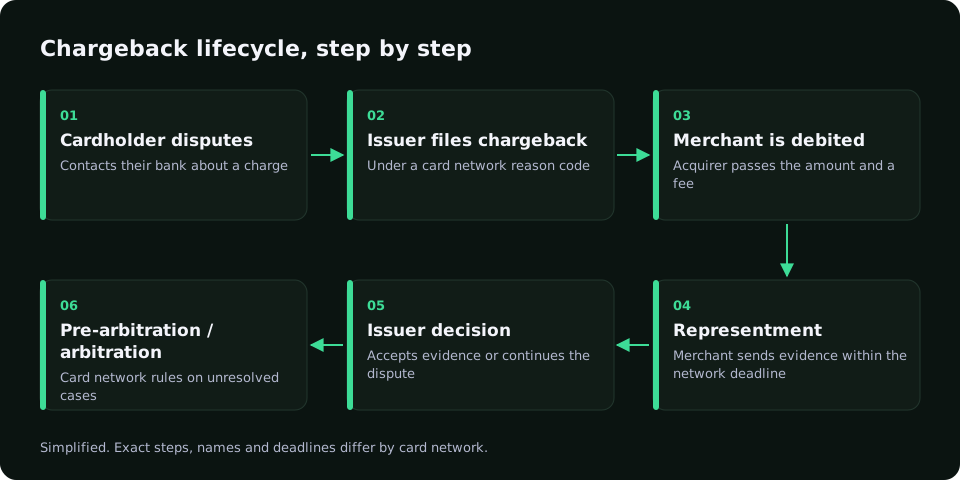
How the chargeback process works, step by step
- The cardholder contacts their bank about a charge they do not recognise, did not receive or are unhappy with.
- The issuer reviews the claim and files a chargeback under a card network reason code.
- The acquirer debits the merchant for the disputed amount and usually adds a dispute fee.
- The merchant chooses to accept the chargeback or submit evidence, which is called representment.
- The issuer reviews the evidence and either reverses the chargeback or keeps it in place.
- If both sides still disagree, the case can move to pre-arbitration and then arbitration, where the card network decides.
Common chargeback reasons
Every card network groups disputes into categories and gives each a reason code. The codes differ between networks, but the categories are close. Knowing which category a dispute falls into tells you what evidence will matter and what to fix in your process.
- Fraud: the cardholder says they did not authorise the payment. Typical for stolen cards used online. Visa groups these under its fraud category, for example 10.4 for card-absent fraud; Mastercard uses 4837 for no cardholder authorisation.
- Item not received: the customer says the goods or service never arrived. Visa 13.1 is the common code.
- Not as described or defective: the item arrived but was different from what was sold.
- Processing errors: duplicate charges, wrong amounts, or charging a card after a cancellation.
- Cancelled recurring transaction: the customer says they cancelled a subscription and were still billed.
- Credit not processed: the customer was promised a refund and did not get it.
Why chargebacks cost more than the sale
The visible cost is the amount of the payment plus the dispute fee your acquirer charges. The real cost is usually higher. If you shipped physical goods, they are gone. Someone on your team spends time collecting evidence. And every dispute counts toward your chargeback ratio, the share of transactions that end in a dispute.
Card networks run monitoring programs for merchants whose dispute or fraud levels pass set thresholds. Being placed in one can bring extra fees, mandatory action plans and, in the worst case, loss of the ability to accept cards through your current acquirer. The exact thresholds and program names change over time, so check the current rules from your acquirer rather than relying on an old blog post.
There is also a quieter cost. When fraud gets through, merchants tend to tighten rules quickly, and tight rules decline good customers. Lost sales from false declines rarely show up in the chargeback report, but they are part of the bill.
Fraud chargebacks versus friendly fraud
Not every chargeback is criminal fraud. Roughly, disputes come from three places. Some are true fraud: a stolen card was used, and the real cardholder rightly wants their money back. Some are genuine service problems: late delivery, a broken item, a confusing cancellation flow. And some are friendly fraud, where the buyer did make the purchase and received what they paid for, but disputes it anyway, sometimes by mistake and sometimes on purpose.
These need different responses. True fraud is best stopped before the payment, with risk scoring, device signals and authentication. Service problems are fixed in operations and support. Friendly fraud is reduced with clear billing descriptors, easy refunds and good evidence. Our article on friendly fraud covers that last group in detail.
How to prevent chargebacks
- Score payments for fraud risk before you capture them, and block or challenge the riskiest ones.
- Use 3-D Secure for payments in the middle risk band; in many cases liability for fraud disputes moves to the issuer when authentication succeeds.
- Make your billing descriptor easy to recognise, so customers do not dispute a charge they simply do not remember.
- Make cancellation and refunds easy to find. A refund you control is cheaper than a dispute.
- Ship with tracking and keep delivery confirmation for orders above your risk tolerance.
- Send every dispute outcome back to your fraud tools so they learn which patterns lead to chargebacks.
How to respond to a chargeback
First, decide whether to fight. If the dispute is valid, such as a real stolen card or an order you failed to ship, accepting it and fixing the cause is usually the right call. If you have strong evidence that the customer made and received the purchase, representment is worth the effort.
Good evidence is specific to the reason code. For item-not-received disputes, that means tracking and delivery confirmation. For fraud disputes, it means proof the real cardholder made the purchase: matching device and IP history, earlier undisputed orders from the same customer, account login records, and 3-D Secure authentication data. Visa's Compelling Evidence 3.0 rules, in force since April 2023, describe how prior undisputed transactions with matching data can be used against certain fraud disputes.
Keep responses short and organised. The person reviewing your case reads many of them. Lead with the strongest fact, attach only what supports it, and meet the deadline your acquirer gives you, since late responses are lost automatically.
Chargeback terms worth knowing
- Issuer: the cardholder's bank, which files the chargeback.
- Acquirer: the merchant's bank or processor, which receives the chargeback and debits the merchant.
- Reason code: the network code that says why the payment was disputed.
- Representment: the merchant's answer with evidence.
- Pre-arbitration and arbitration: later stages where the dispute continues and, finally, the card network rules on it.
- Chargeback ratio: disputes divided by transactions over a period, the number card networks and acquirers watch.
Where RiskCogs fits in chargeback prevention
RiskCogs works before the chargeback happens. Each payment is scored through POST /v1/risk-score and returns a risk_score with readable reason codes, so you can block clear fraud, send the middle band to 3-D Secure or review, and let good customers through. Default bands are allow under 40, review 40 to 69 and block from 70.
When a chargeback arrives, send it to POST /v1/risk-feedback with the riskId so future scores reflect it. The reason codes and device history recorded at payment time are also useful when you build representment evidence. You can start on the free Shadow plan and see what would have been blocked before anything changes for customers.
See what you would have blocked — free shadow modeFrequently asked questions
What is the difference between a chargeback and a refund?
A refund is started by the merchant, who chooses the amount and timing, and normally carries no penalty. A chargeback is started by the cardholder's bank through the card network. The money is pulled back from the merchant, a dispute fee is usually added, and the case counts toward the merchant's chargeback ratio.
How long does a customer have to file a chargeback?
It depends on the card network, the reason code and sometimes the delivery date. For many reason codes the window is counted in months from the transaction or expected delivery date, not days. Your acquirer can tell you the current limits for the networks you accept, since they change over time.
Can a merchant win a chargeback?
Yes. Through representment you send evidence that the charge was valid, such as delivery confirmation, matching device and IP history, earlier undisputed orders or 3-D Secure data. The issuer can then reverse the chargeback. Win rates depend heavily on the reason code and on how specific and well organised the evidence is.
Do chargebacks affect my merchant account?
They can. Acquirers and card networks track your dispute ratio. If it stays above program thresholds, you may face monitoring, extra fees and required remediation plans, and repeated problems can lead to the account being closed. Keeping fraud low and resolving complaints with refunds helps keep the ratio healthy.
Sources and related reading
- Visa, Visa Core Rules and Visa Product and Service Rules (public edition), dispute resolution chapter.
- Visa, Compelling Evidence 3.0 for dispute condition 10.4, effective April 2023.
- Mastercard, Chargeback Guide (merchant edition).
Measure first. Enforce when ready.
Run RiskCogs in shadow mode next to your existing payment setup and review the decisions before they affect a single customer.