
Credit card dispute time limits: cardholder and merchant deadlines
Card networks set how long a cardholder has to dispute a charge and how long a merchant has to respond. For many Visa and Mastercard dispute reasons the cardholder window is commonly about 120 days, with exceptions by reason code. Merchant response windows are much shorter, and your acquirer or provider may set an even earlier internal deadline.
Updated · RiskCogs team
Key facts
- Network rules, not the merchant, set dispute time limits.
- Cardholder windows vary by reason code and can start from the transaction or the expected delivery date.
- Merchant response windows are short and are passed on by the acquirer.
- Consumer protection law, such as the Fair Credit Billing Act in the United States, adds separate billing error rules.
How long cardholders have to dispute
For many Visa and Mastercard dispute reasons, the cardholder window is commonly about 120 days. For goods or services not received, the clock may start from the expected delivery date instead of the transaction date.
Some reasons have different windows, and issuers may apply their own policies on top. Always check the current network rules rather than a fixed number.
Merchant response deadlines
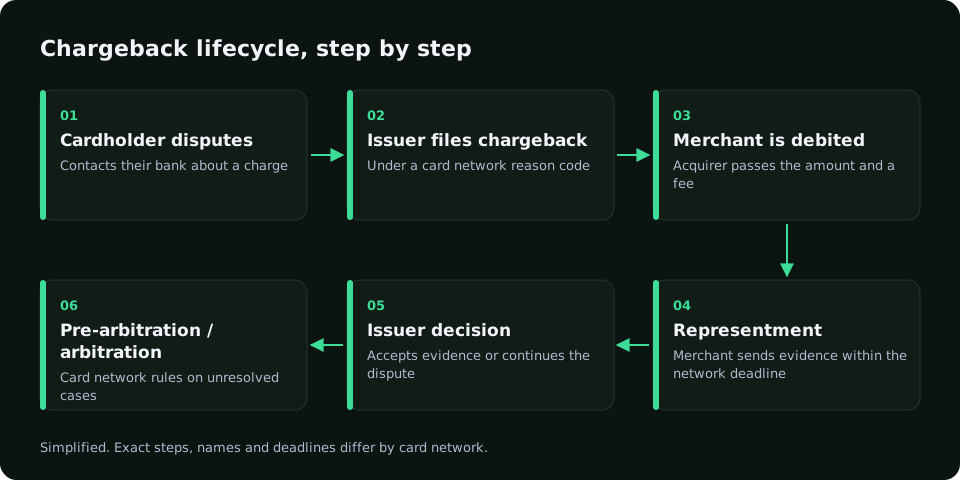
Once a chargeback is filed, the merchant has a short window to accept or submit representment. Your acquirer or payment provider usually sets an internal deadline earlier than the network limit so it can forward your evidence in time.
Missing the deadline usually means the chargeback stands.
Debit cards and consumer law
Debit card disputes follow card network rules too, but consumer protection for electronic transfers is set separately, for example by Regulation E in the United States. How fast the cardholder reports unauthorised use can change their liability.
What merchants should do
- Record the reason code and deadline for every case on arrival.
- Set alerts days before your provider's internal cut-off.
- Keep evidence searchable for at least the full dispute window.
- Track late or missing responses as an operational metric.
How RiskCogs helps with dispute windows
RiskCogs keeps device, IP, account and score reasons for each payment, so the context for an order is still there when a dispute arrives weeks later.
Scoring at checkout also reduces how many fraud disputes reach your queue in the first place. RiskCogs is a risk scoring layer next to your payment provider. It does not process payments and does not file or fight disputes for you. See the pricing page for plans.
See what you would have blocked — free shadow modeFrequently asked questions
How long do you have to dispute a credit card charge?
For many Visa and Mastercard dispute reasons the window is commonly about 120 days, but it depends on the reason code and can start from the expected delivery date. Check your issuer's terms and the current network rules for your case.
Can you dispute a charge after 120 days?
Sometimes. Certain reasons, such as services that were promised for a later date, may use a different start date or a longer window. Issuers may also help outside the network process. It is not certain, so contact the issuer as soon as possible.
How long does a merchant have to respond to a chargeback?
The network sets a response window, and your acquirer or provider often sets an earlier internal deadline so it can forward evidence. Read the deadline on each case notice and plan to submit well before it.
Is the time limit different for debit cards?
Network dispute rules apply to debit cards too, but consumer protection for electronic transfers is set separately, for example by Regulation E in the United States. How fast a cardholder reports unauthorised use can affect their liability.
Sources and related reading
- Visa, Visa Core Rules and Visa Product and Service Rules (public edition), dispute resolution chapter.
- Mastercard, Chargeback Guide (public edition).
- US Fair Credit Billing Act and Regulation E (Electronic Fund Transfer Act), public text.