
Real-time fraud detection: scoring payments before you approve them
Real-time fraud detection scores a payment, login or signup while the user waits, so you can approve, review or decline before money moves. It combines device, network, account and payment signals with rules and models inside the checkout flow. Speed matters, but explainable reasons and safe shadow testing matter just as much for keeping good customers.
Updated · RiskCogs team
Key facts
- Real-time means the decision happens inside the user flow, before authorisation or account creation.
- Batch monitoring finds patterns later; real-time detection stops the event itself.
- Useful inputs include device, IP, email, BIN, velocity and account history.
- Clear reasons on each decision make review and tuning faster.
What real-time fraud detection means
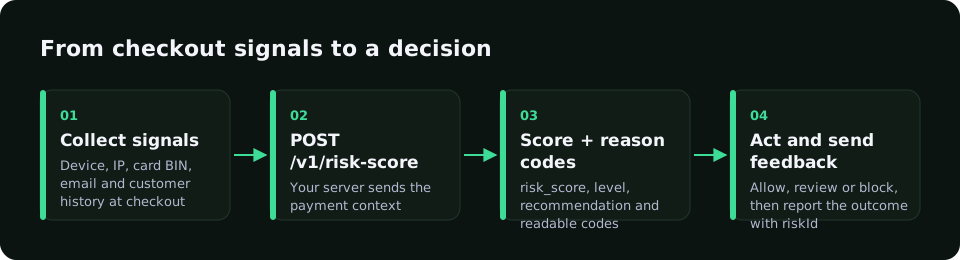
A real-time system receives the event, enriches it with signals, scores it and returns a decision fast enough that the customer does not notice. For card payments that usually means before you send the authorisation.
Post-event monitoring still matters for patterns such as money mules or slow first-party fraud, but it cannot stop a bad order that already shipped.
Signals used in real time
- Device and browser fingerprints.
- IP, proxy and geolocation consistency.
- Email, phone and account age.
- Card BIN, AVS and CVC results from your provider.
- Velocity across cards, devices, accounts and IPs.
- Links to accounts with previous chargebacks.
Real-time vs batch fraud detection
Real-time detection blocks or challenges a single event. Batch or near-real-time monitoring looks across many events to find rings and trends. Mature teams use both and feed batch findings back into real-time rules.
How to roll it out
- Define the decision points: checkout, login, signup, payout.
- Send events with the richest signals you can collect.
- Start in shadow mode and compare scores with real outcomes.
- Set allow, review and decline bands.
- Review false positives and chargebacks weekly and retune.
How RiskCogs does real-time scoring
RiskCogs returns a risk score from 0 to 100 with reasons for each payment through its API, so your checkout can allow, review or decline in the same request. Rules can be tested in shadow mode on live traffic before they act.
Scores combine device, IP, account, BIN and velocity signals across your payment providers. RiskCogs is a risk scoring layer next to your payment provider. It does not process payments and does not file or fight disputes for you. See the pricing page for plans.
See what you would have blocked — free shadow modeFrequently asked questions
What is real-time fraud detection?
It is fraud scoring that runs while the customer is still in the flow, such as checkout or signup. The system enriches the event with signals, scores it and returns allow, review or decline before money moves or the account is created.
How is real-time fraud detection different from transaction monitoring?
Real-time detection decides on one event before it completes. Transaction monitoring often reviews completed transactions over time to spot patterns, such as laundering or rings. Both are useful, and findings from monitoring should feed back into real-time rules.
Does real-time fraud detection slow down checkout?
It should not when it is built well. Scoring calls are designed to return quickly, and most customers never see a challenge. Keep timeouts and a fallback decision in place so a slow call does not block every order.
Can small businesses use real-time fraud detection?
Yes. Start with the signals your payment provider already returns, add device and velocity checks, and test rules in shadow mode first. A scoring layer with clear reasons is easier for a small team to run than a complex rule set.
Sources and related reading
- Visa and Mastercard public guidance on card-not-present fraud controls, named as text sources only.