iGaming fraud prevention: how operators detect bonus abuse and payment fraud
iGaming fraud prevention means spotting players who abuse bonuses, open linked accounts, deposit with stolen cards or move money through the platform, before the loss happens. Operators do it by linking devices, emails, phones and payment details across accounts, scoring deposits and withdrawals in real time, and tuning the rules in shadow mode first.
Updated · RiskCogs team
Key facts
- This guide is for licensed operators and platforms (B2B). It is not advice for players.
- The most common patterns are bonus and promo abuse, multi-accounting, stolen-card deposits, chargebacks after losses, and deposit-withdraw cycling with little play.
- A shared device or IP is a signal, not a verdict: households, offices and mobile networks share them too.
- Fraud controls work next to, not instead of, your KYC, AML and responsible gambling obligations under your licence.
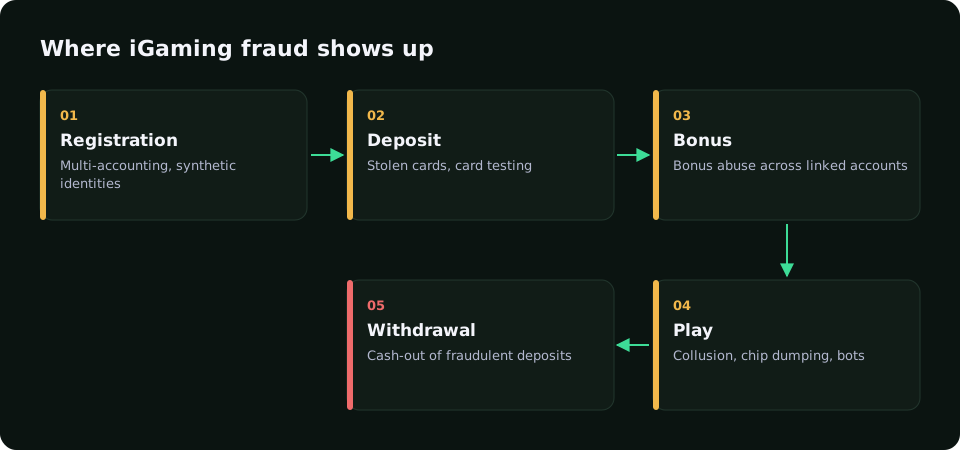
Common types of iGaming fraud
- Bonus abuse: one person claims welcome or reload bonuses again and again through new accounts.
- Multi-accounting: linked accounts share devices, emails, phone numbers or cards to collude or farm promotions.
- Stolen-card deposits: deposits made with compromised cards, often tested first with small amounts.
- Chargeback after loss (friendly fraud): the player disputes a legitimate deposit after losing it.
- Deposit-withdraw cycling: money goes in and out with minimal wagering, which can point to card or bonus abuse.
- Account takeover: a known player account is used from a new device and country to withdraw funds.
Signals operators use to detect it
Single checks are easy to dodge, so operators score signals together. The strongest ones link accounts: the same device seen on many accounts, one email or phone tied to many devices, or one card used by several players.
- Device links: how many accounts used this device in the last 7 days.
- Identity links: emails and phones seen with many devices or IP addresses.
- Deposit velocity: attempts per account, device or card in short windows.
- Location consistency: card country, IP country and browser time zone.
- Network quality: data-center, VPN or Tor IP addresses.
- Automation: webdriver and tampering traces in the browser.
How to roll out iGaming fraud rules safely
- Start with signup, bonus claim, deposit and withdrawal as separate decision points.
- Run rules in shadow mode and compare flagged players with confirmed outcomes from your risk and payments teams.
- Use review and step-up actions before hard blocks, since false positives cost real players and revenue.
- Feed confirmed outcomes, such as chargebacks and confirmed bonus abuse, back into the scoring.
- Revisit thresholds after each new promotion, market launch or payment method.
iGaming fraud patterns and matching controls
| Pattern | Key signals | Typical control |
|---|---|---|
| Bonus abuse | Shared device across new accounts, repeated signups | Hold bonus, manual review |
| Multi-accounting | Device, email, phone and card links | Link accounts, restrict promotions |
| Stolen-card deposits | Card velocity, BIN country mismatch, small test deposits | Challenge with 3-D Secure, block card |
| Chargeback after loss | Dispute history on email, phone or card | Lower limits, step-up verification |
| Account takeover | New device and country before withdrawal | Step-up before payout |
How RiskCogs supports iGaming operators
RiskCogs scores signups, deposits and withdrawals with readable signals: device links across accounts, emails and phones seen on many devices or IPs, card and deposit velocity, BIN and geo mismatches, data-center and Tor IPs, and browser automation. Device data is collected only with user consent and identifiers are hashed.
Rules run in shadow mode next to your existing payment providers and compliance tools, so your team sees what would have been flagged before any player is affected.
device.accounts_7d > 6 AND bonus.claimed = true
→ score +35 · recommendation: reviewFrequently asked questions
What is bonus abuse in iGaming?
Bonus abuse is when a person or group claims promotions they are not entitled to, usually by opening several accounts, using matched betting, or colluding at the same table. It is one of the most common losses for operators. Detection relies on linking accounts through devices, identities and payment details rather than on a single signal.
How do operators detect multi-accounting?
They link accounts that share strong identifiers: the same device, browser fingerprint, email pattern, phone number or card. Each link adds to a score, and accounts above a threshold go to review. Because families and shared networks also overlap, operators should combine several links and review cases before closing accounts.
Can fraud rules replace KYC checks?
No. Fraud scoring and KYC answer different questions. KYC confirms who the player is under your licence rules, while fraud scoring looks at behaviour, devices and payments in real time. Operators use both, and fraud signals often decide when to ask for extra verification earlier than the normal KYC trigger.
Why test iGaming fraud rules in shadow mode?
Shadow mode scores real traffic without changing any decision. You can see how many players a rule would have flagged, compare that with confirmed abuse and chargebacks, and adjust thresholds before enforcing. It lowers the risk of blocking good players, which matters during promotions and new market launches.
Sources and related reading
- UK Gambling Commission, Licence conditions and codes of practice (LCCP), anti-money laundering and customer interaction sections.
- Malta Gaming Authority, Player Protection Directive and AML/CFT guidance for gaming licensees.
Measure first. Enforce when ready.
Run RiskCogs in shadow mode next to your existing payment setup and review the decisions before they affect a single customer.