E-commerce fraud prevention: how online stores stop fraud at checkout
E-commerce fraud prevention means scoring every order before you capture payment, using device, network, card BIN, email and customer-history signals. Low-risk orders pass, unclear ones go to review and clear fraud is blocked. Start by measuring in shadow mode, then enforce rules once you know how many good customers they would affect.
Updated · RiskCogs team
Key facts
- The most common online store fraud types are stolen-card purchases, card testing, account takeover, refund abuse and friendly fraud.
- Every fraud decision has two costs: missed fraud becomes chargebacks, and false declines turn away real customers.
- No single signal is enough. Combine device, IP, BIN, email and order history into one score.
- Track fraud rate, chargeback rate, approval rate and manual review rate together, not one at a time.
Types of e-commerce fraud to plan for
Most stores see a mix of the same few patterns. Knowing which ones hit you shapes which signals and rules matter most.
- Stolen-card fraud: a real card used without the owner, often for resellable goods.
- Card testing: many small attempts to check which stolen cards still work.
- Account takeover: a criminal logs into a real customer account and uses its saved cards or balance.
- Refund and return abuse: claiming items never arrived or returning different goods.
- Friendly fraud: a real customer disputes a purchase they made.
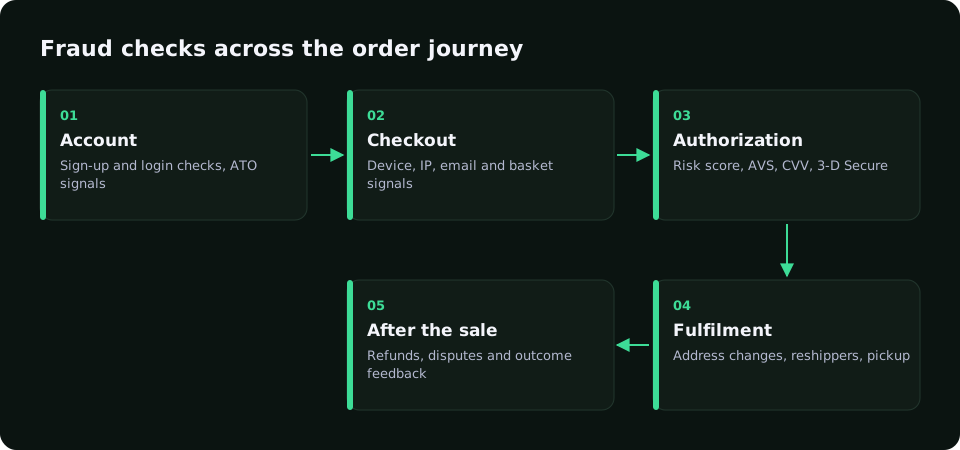
An e-commerce fraud prevention plan in six steps
- Collect checkout signals: device, IP, email, phone, shipping and billing data, card BIN.
- Score each order with those signals plus the customer history you already have.
- Set three outcomes: approve, review and block, with thresholds you can tune.
- Run rules in shadow mode first and compare their decisions with real outcomes.
- Send outcomes back (approved, refunded, charged back) so the score learns from your data.
- Review rules monthly and after every new attack pattern.
Common store fraud signals
| Signal | Why it matters | Typical action |
|---|---|---|
| Many devices or IPs per email | Shared or stolen identity | Raise score, review high-value orders |
| Prepaid or virtual BIN | Harder to trace funding | Add to score; do not block on this alone |
| Billing, IP and shipping country mismatch | Possible stolen card or proxy | Review or step up with 3-D Secure |
| Disposable email address | Low-commitment identity | Raise score for first orders |
| Earlier chargebacks or refunds | Known risky history | Review or block per your policy |
| Same device as a past approved order | Returning good customer | Lower score, approve faster |
How RiskCogs helps online stores
RiskCogs returns a risk score with readable reason codes for each order, such as BIN country versus IP mismatch, disposable email, data-center IP, chargeback history or a device that matches a past approved order. By default scores under 40 are allow, 40 to 69 review and 70 or more block, and you can tune those bands.
You can start free in shadow mode next to your current payment provider and see what RiskCogs would have decided before it changes any order.
See what you would have blocked — free shadow modeFrequently asked questions
What is the best way to prevent e-commerce fraud?
Use layered checks instead of one hard rule. Score each order with device, network, card BIN, email and history signals, send unclear orders to review, and use 3-D Secure where risk is high. Test new rules in shadow mode first so you can see how many good customers they would block before you turn them on.
How do I reduce false declines in my store?
Give returning customers credit for their history, avoid blocking on a single weak signal such as a VPN, and route borderline orders to review instead of declining them. Measure approval rate next to fraud rate, and check every new rule in shadow mode before it affects real orders.
Is 3-D Secure enough to stop online store fraud?
No. 3-D Secure helps with stolen-card fraud and can shift liability, but it adds friction and does not stop refund abuse, friendly fraud or account takeover through saved cards. Use it for higher-risk orders that your risk score flags, rather than on every payment.
Which metrics should I track for fraud prevention?
Track the fraud rate, the chargeback rate, the approval rate, the manual review rate and the time it takes to review an order. Looking at them together shows whether a new rule really cuts fraud or just moves the cost into lost sales and extra review work.
Sources and related reading
- Visa, Visa Core Rules and Visa Product and Service Rules (public edition).
- European Banking Authority, guidelines on strong customer authentication under PSD2.
Measure first. Enforce when ready.
Run RiskCogs in shadow mode next to your existing payment setup and review the decisions before they affect a single customer.